
Beating Burnout: Simple Steps to Reclaim Your Energy
Beating Burnout: Simple Steps to Reclaim Your Energy
Burnout isn’t just feeling tired after a long day.
It’s that bone-deep exhaustion that sleep can’t fix.
The kind that makes you question everything you’re doing.
If you’re reading this at 2 AM because you can’t switch off your brain, you’re not alone.
73% of Australian adults report experiencing burnout symptoms. That’s nearly 3 out of 4 people walking around completely drained.
But here’s the thing most people miss:
Burnout isn’t a character flaw. It’s your body’s alarm system telling you something needs to change.
The Hidden Cost of Pushing Through
Sarah thought she was being productive.
Working 12-hour days. Skipping meals. Living on coffee and willpower.
Sound familiar?
Her energy crashed harder than a house of cards in a tornado.
Women’s health research shows that chronic stress depletes our adrenal glands faster than we can refill them.
Your body isn’t designed to run on empty indefinitely.
Every time you push through exhaustion, you’re making a withdrawal from your energy bank account.
Without deposits, you’ll eventually go bankrupt.
Why Traditional Advice Fails
“Just get more sleep.”
“Take a vacation.”
“Practice self-care.”
If it were that simple, burnout wouldn’t be an epidemic.
The problem with most stress management advice?
It treats symptoms, not root causes.
Real recovery requires a holistic approach that addresses your entire lifestyle.
Not just the obvious stuff like sleep and exercise.
We’re talking about nutrition, movement, mindset, and behavior change that actually sticks.
The Energy Audit: Where’s Your Power Leaking?
Before you can fix your energy crisis, you need to know where it’s going.
Think of yourself as a smartphone with a battery drain issue.
Some apps are obvious energy vampires. Others run silently in the background, slowly killing your charge.
Physical Energy Drains:
- Poor sleep quality (not just quantity)
- Blood sugar rollercoasters from processed foods
- Sitting for 8+ hours daily
- Dehydration (even mild)
Mental Energy Drains:
- Decision fatigue from too many choices
- Perfectionism and over-thinking
- Saying yes when you mean no
- Information overload
Emotional Energy Drains:
- Toxic relationships
- Unresolved conflicts
- Comparing yourself to others
- Suppressing emotions
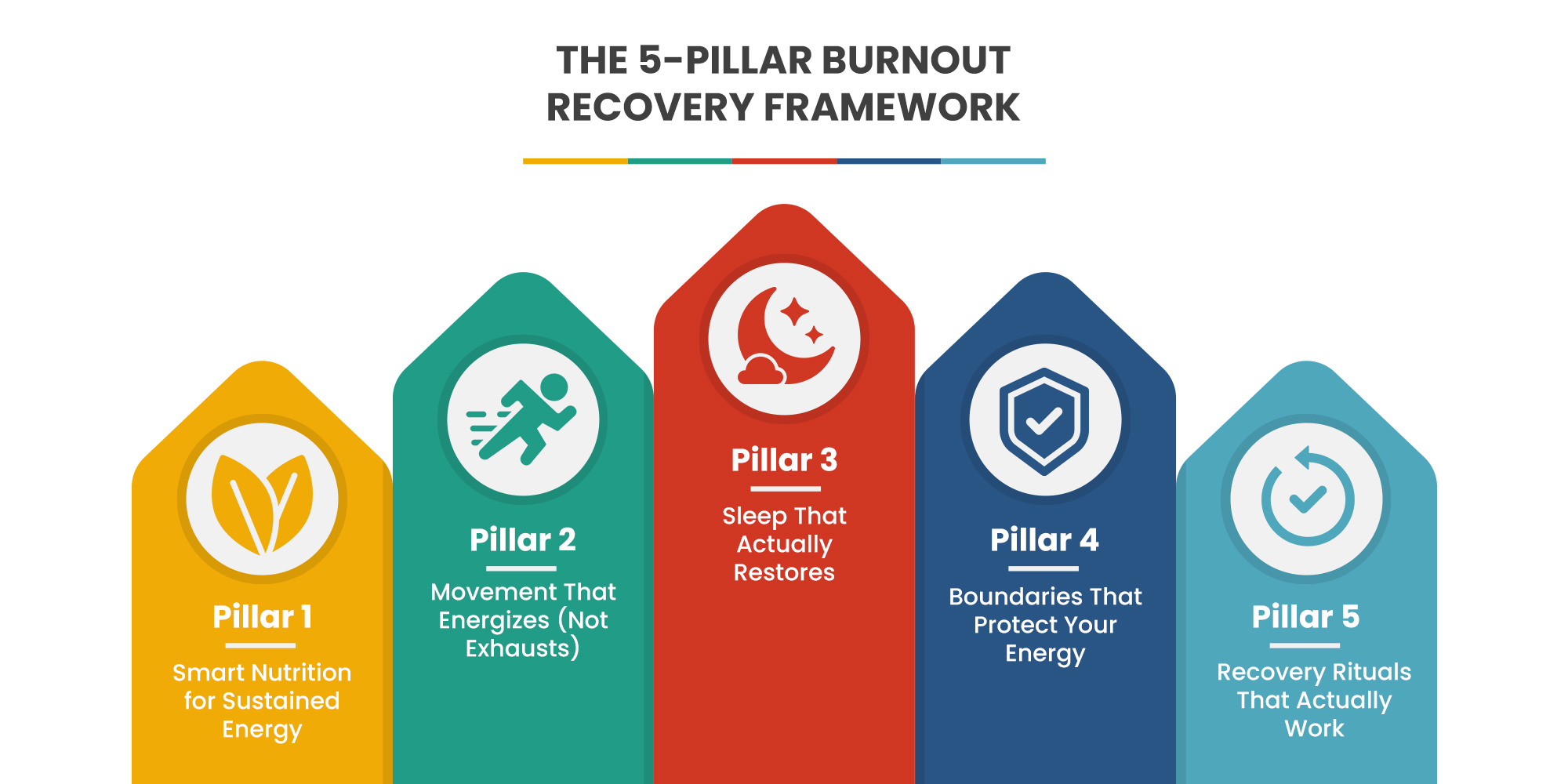
The 5-Pillar Burnout Recovery Framework
The 5-Pillar Recovery Framework
Pillar 1: Smart Nutrition for Sustained Energy
Forget fad diets and complicated meal plans.
Energy-stable eating is about timing and quality, not restriction.
The 3-4-5 Rule:
- Eat within 3 hours of waking
- Every 4 hours after that
- Stop eating 5 hours before bed
Focus on foods that keep your blood sugar steady:
Protein + Fiber + Healthy Fats
Think: Greek yogurt with berries and nuts, not a banana on its own.
Your brain uses 20% of your daily energy. Feed it properly.
Pro tip: If you crash at 3 PM every day, your lunch isn’t working.
Pillar 2: Movement That Energizes (Not Exhausts)
Exercise shouldn’t leave you more tired than when you started.
If your workouts are draining you, you’re doing it wrong.
The Goldilocks Zone: Just enough to boost circulation and mood, not so much that you need a nap.
Energy-Boosting Movement:
- 10-minute morning walks
- Desk stretches every hour
- 5-minute dance breaks
- Gentle yoga before bed
Fitness doesn’t have to mean crushing yourself at the gym.
Sometimes the most personalized coaching advice is: “Do less, feel better.”
Pillar 3: Sleep That Actually Restores
You can sleep 8 hours and still wake up exhausted.
Quality beats quantity every time.
Sleep isn’t just about being tired.
It’s when your body repairs, your brain detoxifies, and your hormones reset.
The 3-2-1 Rule:
- 3 hours before bed: No more food
- 2 hours before bed: No more work
- 1 hour before bed: No more screens
Room temperature matters: 18-20°C is optimal for deep sleep.
Light exposure matters: Bright light in the morning, darkness at night.
Your circadian rhythm isn’t a suggestion. It’s biology.
Pillar 4: Boundaries That Protect Your Energy
The word “no” is a complete sentence.
Boundaries aren’t walls. They’re gates with you as the gatekeeper.
Every yes to something unimportant is a no to something that matters.
Energy Protection Strategies:
- Time-block your calendar
- Turn off non-essential notifications
- Set specific work hours
- Create phone-free zones
Behavior change starts with awareness.
Track your energy for one week. Notice patterns.
What activities boost you? What drains you?
Double down on the boosters. Minimize the drains.
Pillar 5: Recovery Rituals That Actually Work
Recovery isn’t what happens when you collapse.
It’s what you build into every day.
Micro-recoveries are more powerful than weekend marathons of rest.
5-Minute Reset Techniques:
- Box breathing (4-4-4-4 pattern)
- Cold water on wrists and face
- Gratitude journaling
- Progressive muscle relaxation
Weekly Reset Rituals:
- Digital detox for 2 hours
- Nature connection (even urban parks work)
- Creative activities (cooking, crafting, music)
- Social connection without agenda
When to Seek Professional Help
Sometimes burnout runs deeper than lifestyle changes can fix.
Chronic conditions like thyroid disorders, adrenal fatigue, or depression can masquerade as simple exhaustion.
Red flags that warrant professional support:
- Sleep doesn’t restore energy
- Simple tasks feel overwhelming
- Physical symptoms (headaches, digestive issues)
- Mood changes lasting weeks
Health coaching can bridge the gap between medical treatment and daily habits.
A good coach helps you implement changes that stick, not just understand what you “should” do.
Your 7-Day Energy Comeback Plan
Day 1-2: Energy audit – track what drains and boosts you
Day 3-4: Implement the 3-4-5 eating rule
Day 5-6: Add 10-minute morning movement
Day 7: Create your first boundary (say no to one energy drain)
Week 2: Build your sleep sanctuary
Week 3: Establish micro-recovery rituals
Week 4: Assess and adjust
Small changes compound into big results.
You don’t need to overhaul your entire life overnight.
The Truth About Sustainable Energy
Energy isn’t about pushing harder.
It’s about working smarter with your biology, not against it.
Your body has an incredible capacity for vitality when you give it what it needs.
The paradox: Slowing down often speeds up your results.
Rest isn’t earned through exhaustion. It’s required for peak performance.
Take Action Today
Pick one thing from this article.
Not five things. One.
Behavior change happens through consistent small actions, not dramatic overhauls.
Your future self will thank you for starting today.
Remember: You’re not broken. You’re not lazy. You’re human.
And humans need energy to thrive, not just survive.
Contact me if you need any help.
Disclaimer: This information is for educational purposes only and doesn’t replace professional medical advice. Always consult your healthcare provider before making significant changes to your health routine.